
The crow: the bird that baffled scientists with its amazing intelligence
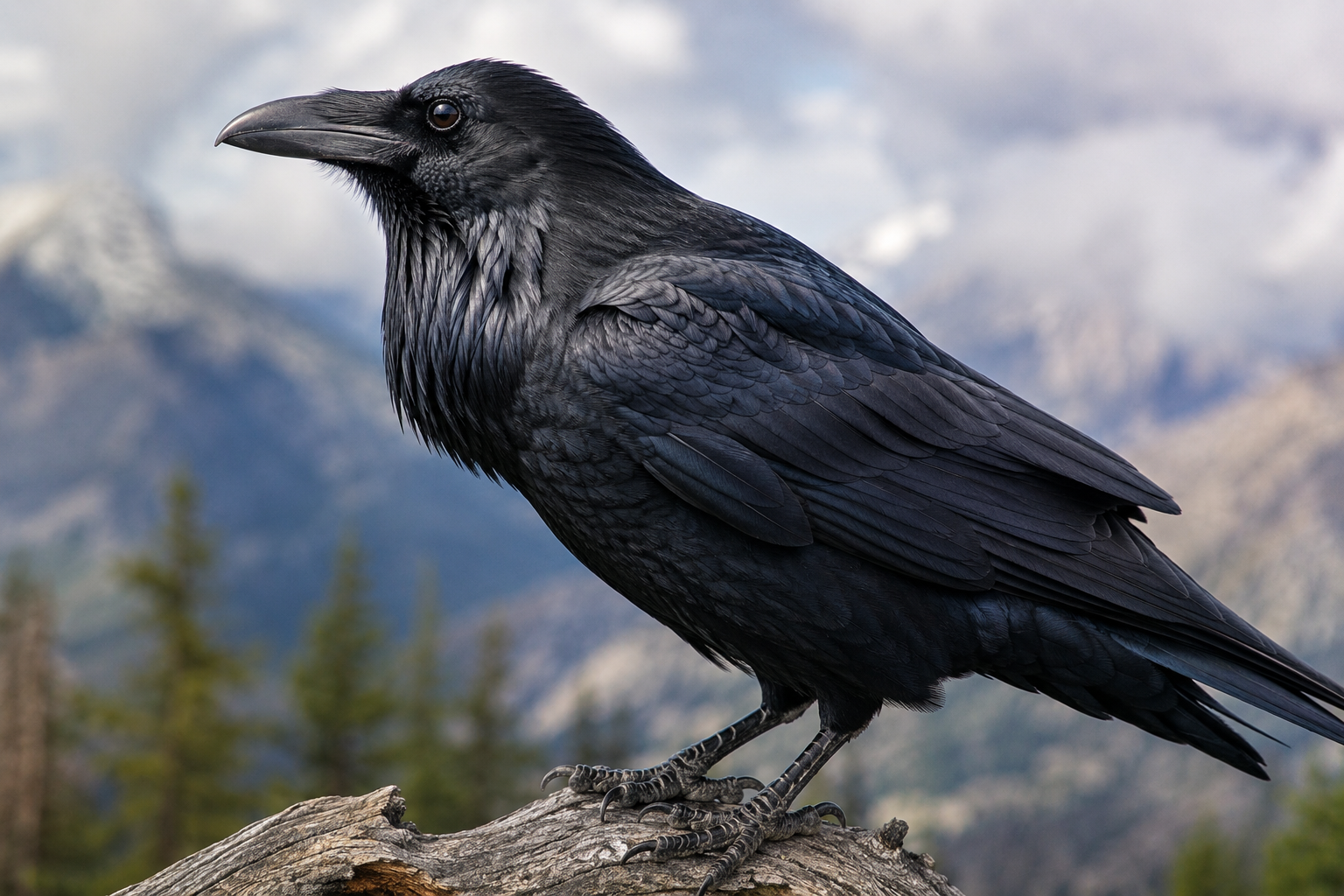
For thousands of years, the raven has been associated in the human imagination with mystery and symbolism, appearing in myths and folktales as a symbol of wisdom at times, and of bad luck at others. But modern science has revealed a different side to this black bird; a side that almost rivals the intelligence, learning abilities, and memory of some higher mammals. The raven is not merely a bird that caws in the trees or hovers in the sky; today, it is considered one of the most intelligent living creatures on Earth.
The crow belongs to the Corvidae family, the same family that includes ravens, jays, and great black crows. Studies have shown that the crow's brain, despite its small size compared to the human brain, has a high neural density, granting it remarkably advanced cognitive abilities.
Unforgettable memory of faces
One of the most fascinating facts about crows is their ability to remember human faces for years. Researchers at the University of Washington conducted an experiment in which some people wore specific masks while capturing a number of crows, then released them later. Surprisingly, the crows did not forget those faces; rather, they began attacking anyone wearing the same mask, even years later, as if they were keeping a special record of people who posed a threat to them.
What's most surprising is that crows don't keep this information to themselves; they pass it on to the rest of the group, as if practicing a kind of "social learning." If a crow is threatened by a particular human, other crows might also begin warning about that person, even if they've never encountered them before.
When a crow invites its friends to a meal
Another striking behavior is that some crow species call to their companions when they find an abundant food source. Instead of keeping the food all for themselves, they make specific calls that attract other crows to the area. Scientists believe this behavior reflects a high level of social organization and cooperation within the group.
It has also been observed that crows keep an eye on each other while storing food, and if they sense that another crow is watching them, they may later return to move their stock to a safer place, which demonstrates their ability to plan and anticipate.
Using tools and solving problems
The crow is one of the few animals capable of using and making tools. In numerous scientific experiments, crows have been able to bend wires to turn them into hooks to catch food, and they have also used sticks to extract insects from narrow holes.
In some tests, it was able to solve complex problems that required carrying out successive steps to reach a food reward, an ability previously thought to be exclusive to great apes.
Some researchers suggest that the intelligence of a crow is comparable to that of a human child between five and seven years old in some cognitive skills.
Does the crow communicate in a special language?
The crow has a sophisticated communication system that relies on a variety of sounds and movements. Scientists have observed that the tones of their caws vary depending on the danger or the type of message, and that crows can understand social cues within the group very quickly.
Observations also showed that crows hold something like “funerals” when one of their members dies; they gather around the body and make collective sounds. Scientists believe that this behavior may be a way to learn the causes of danger and avoid it in the future.
The raven in human cultures
The raven was strongly present in many civilizations. In some ancient cultures it was a symbol of wi