Sam Halabi
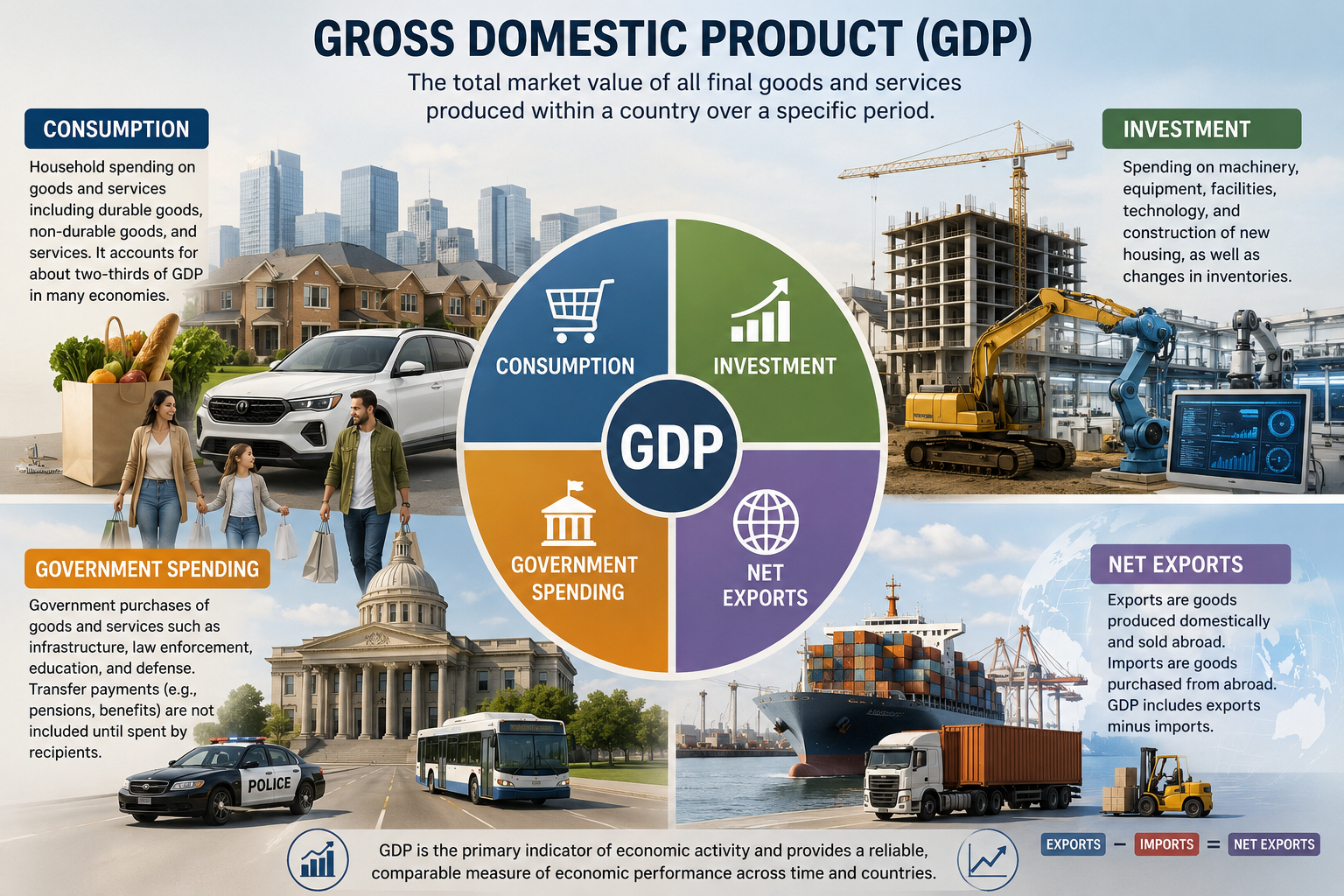
Gross Domestic Product (GDP) represents the total market value of all final goods and services produced within a country over a specific period. As a measure of the value generated by an economy spanning sectors such as industry, services, construction, and technology GDP is regarded by economists as the primary indicator of economic activity
Although GDP does not capture every form of productive activity, it provides a reliable and comparable method for assessing economic performance across different time periods and countries
Consumption: Consumption household spending on goods and services accounts for the largest share of GDP
This category includes durable goods (automobiles), non-durable goods (e.g., food), and services- (healthcare, housing rentals, and education). Since consumption typically makes up about two-thirds of GDP in many economies, fluctuations in household confidence and spending can significantly impact overall economic growth
Investment GDP also includes investment spending aimed at building future productive capacity. Businesses invest in machinery, equipment, production facilities, and technology, while households invest through the construction of new housing. Additionally, businesses adjust their inventories to account for goods that have been produced but not yet sold. Investment plays a key role in expanding future production capabilities and serves as a driving force for long-term growth
Government Spending: Another component is government spending on goods and services, such as infrastructure development, law enforcement, education, and defense
It is important to note that GDP includes only actual government purchases of products; transfer payments (such as pensions or social benefits) are not included in the calculation. Such transfer payments are counted as economic activity only when the recipients spend the funds; at that point, they are reflected in the "consumption" category
Net Exports Finally, GDP accounts for the impact of international trade through the "net exports" component (exports minus imports)
Exports are included in GDP because they represent goods produced domestically and sold abroad, whereas imports are subtracted because they reflect spending on goods produced in other countries
Such adjustments ensure that GDP measures the volume of output produced specifically within the country